A commissioned buyer-side analysis of Wood-Destroying Organism inspection reports. Delivers two documents: a private Buyer Intelligence Report with full scope synthesis, lender analysis, and negotiation considerations, plus an editable Seller Repair Request Letter ready to customize and send.
A WDO inspection report identifies what was found. It does not tell the buyer what to ask for, how to prioritize treatment, or whether the findings affect their loan. The Termite Letter closes that gap with two documents: a private intelligence report for the buyer's strategy, and an editable letter for the seller's response.
A private analytical document for the buyer and buyer's agent. Not intended to be sent to the seller. This is where strategy, uncertainty, and negotiation reasoning live.
A concise, professional letter addressed to the seller or seller's agent. Delivered as an editable .docx so the buyer and agent can customize tone, scope, and specific asks before sending.
Upload your WDO inspection report PDF. Tell us about the property, loan type, and who the letter should be addressed to. A flat fee of $79 is quoted at commission.
One operator reviews the WDO report, extracts and classifies every finding, assigns severity and treatment urgency, estimates cost brackets, assesses lender impact, and produces the response letter with remediation requests organized by priority.
Turnaround clock starts when we receive your documents. Both deliverables arrive by email as editable .docx files, typically same-day.
Dominant transaction risks at a glance: finding counts by severity, total remediation range, lender clearance items. The first page tells the buyer what matters most.
Findings grouped into contractor-scoped repair domains. Each domain has a cost range, uncertainty assessment, and sequencing recommendation. This is how the work actually gets quoted and done.
For VA and FHA transactions, a 4-tier classification: clearance required, appraiser concern, documentation gap, or no lender relevance. Only the clearance tier appears in the seller letter.
Which findings provide leverage, which are better as credits than repairs, and which to deprioritize. This section never leaves the buyer's hands.
Case-specific advice for customizing the seller letter: which items to keep, which to remove, when to request credits instead of repairs, and how to calibrate tone for the transaction.
Every finding with severity, category, evidence basis, cost bracket, and citation to the original report. The full analytical record backing everything in both documents.
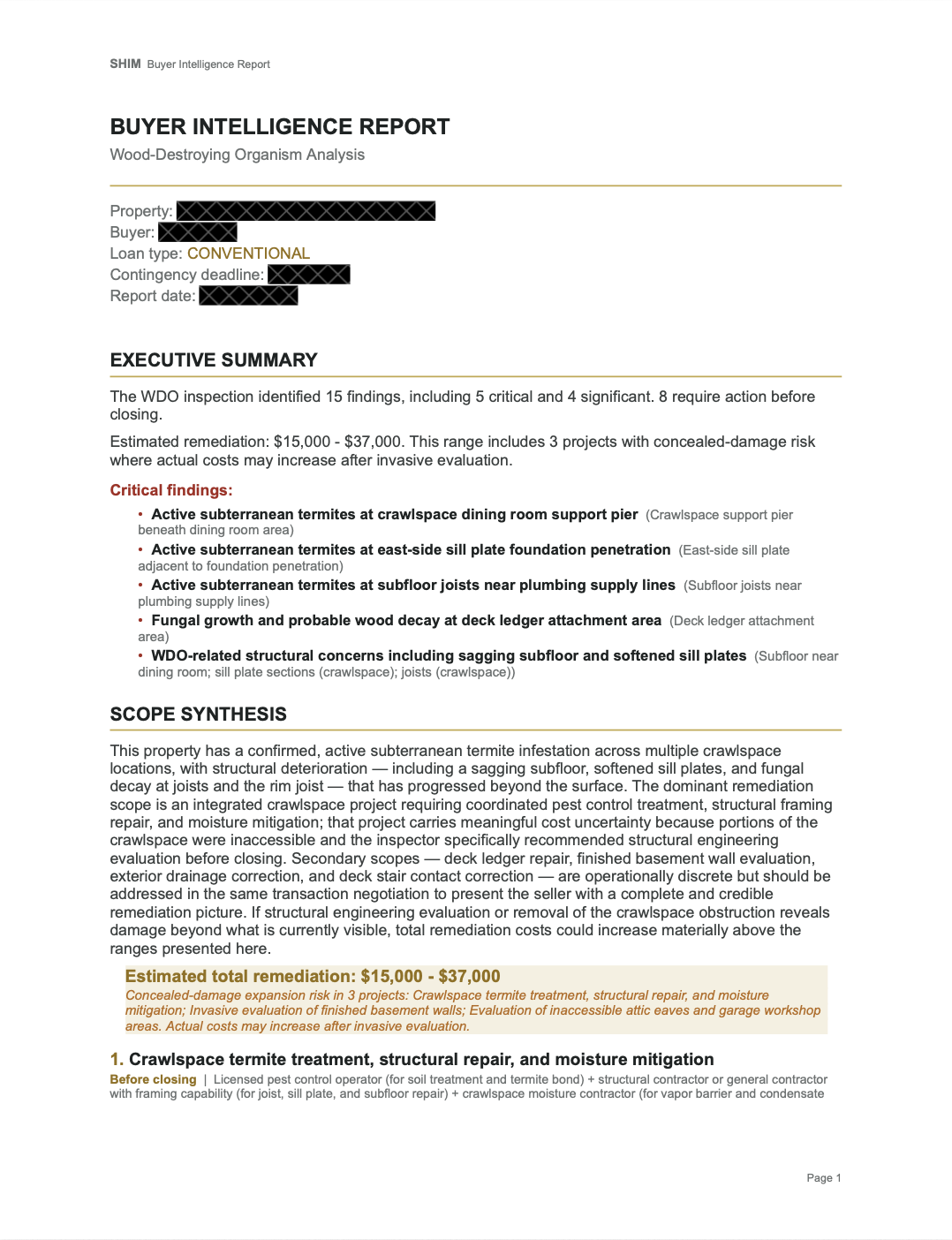
Every Termite Letter produces two documents. The sample below is the buyer intelligence report, which analyzes the WDO inspection and surfaces where your leverage sits. The second document is an editable draft letter you can send to the seller.
 Sample
A sample report showing how WDO findings are classified by severity and lender sensitivity, grouped into contractor-scoped repair domains, and framed for negotiation. This is the private analytical document for the buyer and buyer's agent.
Every finding and cost estimate in the letter is tagged with one of five evidence tiers, so the reader can calibrate trust appropriately. The same framework is used across all Shim products.
Directly stated in the WDO inspection report. The verbatim excerpt supports the claim with no interpretation. "Live subterranean termites observed at north sill plate."
Calculated from stated observations through straightforward inference. Total treatment scope derived from multiple stated findings. Structural implications derived from damage location.
Draws on knowledge not in the report: treatment cost ranges (industry benchmark), VA/FHA lender requirements (lending convention), regional termite pressure data (regional convention). Always labeled.
A single active termite infestation left untreated can cause thousands in structural damage. A WDO report with findings on a VA loan can delay or block closing if not addressed properly. $79 gets your client a private intelligence report and an editable repair request letter that turn a technical report into a negotiating instrument.
Covers both documents: the private buyer intelligence report and the editable seller repair request letter.
The fee is the same whether the deal closes, renegotiates, or collapses. Shim is not compensated on outcome, only on producing the analysis that helps the buyer respond to the inspection report with clarity and priority.
A Wood-Destroying Organism (WDO) inspection report documents the presence or absence of termites, carpenter ants, wood-boring beetles, and wood decay fungi in a structure. Most states use the NPMA-33 form or a state-specific equivalent. The report is typically ordered during the due diligence period and is often required by lenders, especially for VA loans.
No. The Termite Letter is a structured analytical response to the inspection report. It classifies findings, estimates treatment costs, and produces two documents: a private intelligence report for the buyer's strategy and an editable letter for the seller. It is not a pest control assessment, treatment plan, or warranty. Your pest control professional remains the authority on treatment specifics and execution.
Yes. VA loans require a clear WDO report in most states, meaning active infestations must be treated and the property re-inspected before closing. FHA loans may have similar requirements depending on the state and appraiser findings. The letter flags which findings affect lender clearance and what needs to happen before closing for each loan type.
Treatment cost brackets are convention-basis estimates drawn from industry pricing data. They provide a reasonable range for negotiation but are not quotes. Actual treatment costs vary by provider, scope, structure size, and local market conditions. The letter labels all cost estimates as convention-basis so both parties understand the source.
If the inspection report shows no evidence of WDO activity, the letter will note the clean result and any conducive conditions or preventive recommendations. A clean report is a good result. The letter may still be useful if there are conducive conditions the buyer should address or if lender documentation is needed.
Yes. Agents frequently commission termite letters on behalf of their buyers. The letter is addressed to the seller or seller's agent per the buyer's instructions. The flat fee is the same regardless of who initiates the commission.
Fill out a short intake form. We respond with acceptance, a turnaround commitment, and a payment link.