A commissioned buyer-side analysis of an HOA or condo governance package, delivered as a ranked red-flag memo with tiered financial exposure, cross-document analysis, and specific follow-up questions for your attorney and HOA management.
An HOA governance package is typically 100 to 400 pages of CC&Rs, bylaws, budgets, reserve studies, meeting minutes, insurance summaries, and disclosure letters. Nobody in the transaction is paid to read all of them cover to cover for the buyer's side. The HOA Document Review does that reading, surfaces the red flags that matter, ranks them by severity, and tells you exactly what to ask your attorney and HOA management before closing.
A structured analysis of the governance package organized around what creates financial exposure and legal risk for the buyer.
The highest-value output is not a summary of rules. It is the identification of where the documents are silent, contradictory, or incomplete.
You received a governance package and closing is weeks away. You want to know what financial exposure the documents create, which restrictions affect your intended use, and what questions to bring to your attorney before you sign.
Your buyer is purchasing in a community with governance documents you do not have time to read in full. You need a clear-eyed assessment of the package so your client can make an informed decision, and so you have documentation that the risks were surfaced before closing.
You are reviewing the governance package as part of the closing process. The red-flag memo gives you a pre-sorted set of issues with citations, financial exposure estimates, and specific questions already drafted, so your review time is spent on judgment, not extraction.
Everyone else in the transaction either does not read the full package, reads it from the seller's perspective, or charges hourly rates that make page-by-page analysis impractical for most deals. Shim reads every page for a flat fee, with no interest in whether the deal closes.
May flag obvious concerns from the resale certificate but does not typically read the CC&Rs, bylaws, budget, and reserve study cover to cover. Commission-dependent compensation creates a structural tension with surfacing deal-breaking red flags.
Reviews the package when retained, but billing hourly against a 300-page governance package means either abbreviated review or a legal bill that exceeds the cost of the memo by an order of magnitude.
Produces the disclosure package and answers buyer questions. Employed by the association, not the buyer. Not positioned to flag problems with the community's own financial health or governance structure.
Shim is compensated when the commission is accepted and the review is produced. Whether the deal closes, renegotiates, or collapses has no effect on the fee. The only inputs are what the governance documents say and what the buyer needs to know.
Email or upload your HOA document package: CC&Rs, bylaws, budget, reserve study, meeting minutes, insurance summary, and any disclosures. Include your review period deadline and closing date. A flat fee of $149 is quoted at commission, before production starts.
One operator reads every document in the package, extracts and classifies every finding, runs cross-document analysis to surface tensions and contradictions, and produces the ranked red-flag memo with tiered financial exposure and follow-up questions.
Turnaround clock starts when we receive your documents. The red-flag memo arrives by email as a PDF, typically same-day. Each finding includes the evidence basis so you know which claims are documented in the package and which are analytical inference.
One-page summary matrix of every finding with severity, category, urgency, and evidence basis. Designed for the attorney who needs a scannable overview before reading the detail.
A single paragraph summarizing the package: clean with minor concerns, significant issues requiring attorney attention, or structural problems that should give the buyer serious pause.
Aggregated financial risk broken into three tiers: known obligations (documented and quantified), probable exposures (strongly implied), and speculative scenarios (contingent on future events).
Every finding ranked by severity and urgency, with plain-language explanations, financial impact estimates, evidence basis tags, and specific follow-up questions for the buyer's attorney or HOA management.
Patterns that only emerge from reading across documents: authority granted in CC&Rs but exercised in minutes, reserve studies contradicted by budgets, enforcement rules inconsistent with recorded practice.
State-specific considerations relevant to the findings. Which HOA statutes apply, whether the association has opted into protective provisions, and where the buyer's attorney should verify enforceability.
Consolidated checklist of every follow-up question from the findings, split into two sections: questions for the buyer's attorney and questions for HOA management. Designed to be printed and handed off directly.
Every claim in the memo is tagged with a 5-tier confidence framework: Stated (verbatim from the documents), Derived (calculated from stated figures), Convention (industry norms or lender guidelines), Modeled (contingent scenarios), or Operator (added during expert review). You always know what comes from the documents and what comes from analysis.
Every review follows the same structure. A redacted sample is available so you can see the shape of the deliverable before you commission one of your own.
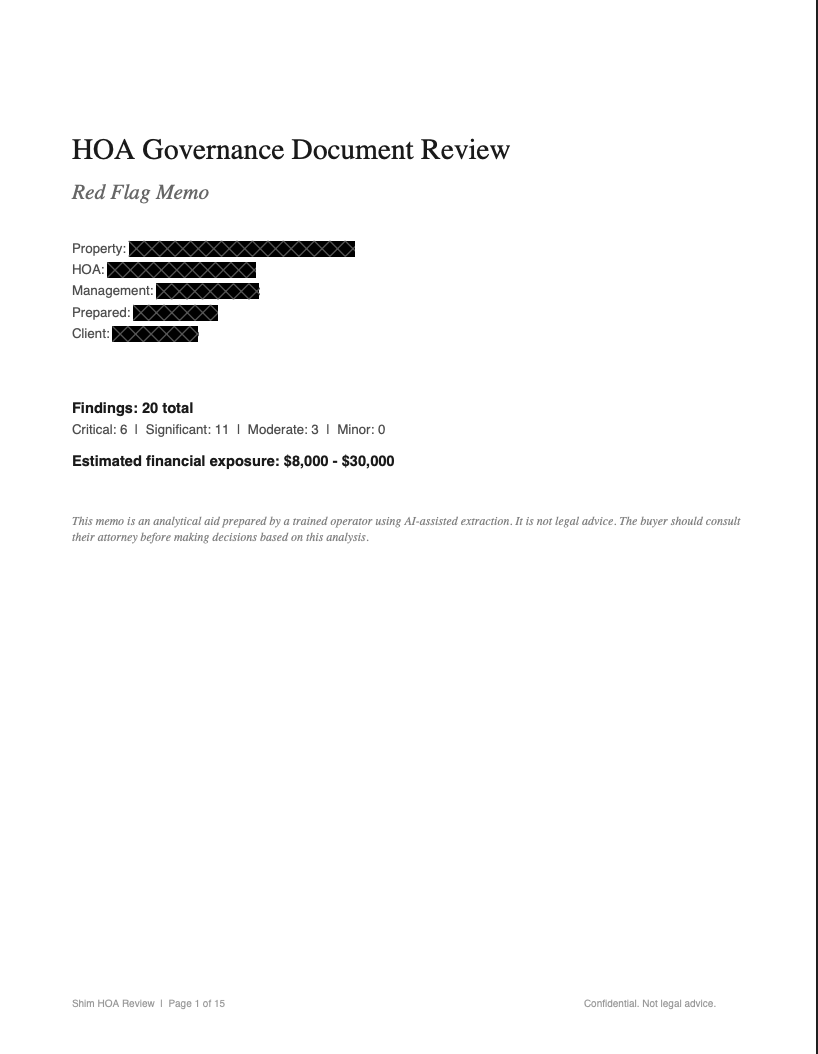 Sample
A sample red-flag memo showing how findings are ranked, how financial exposure is tiered across known, probable, and speculative categories, and how cross-document tensions are surfaced from the governance package. 15 pages, 20 findings.
A single special assessment buried on page 180 of a governance package can cost an owner $5,000 to $25,000. A reserve fund at 30% funding signals tens of thousands in future assessments that the current dues do not reflect. One undisclosed litigation matter can change the carrying cost of a unit for years. The flat fee is set against that reality.
Covers the full governance package review and the red-flag memo. One price, regardless of package length or finding count.
The fee is the same whether the deal closes, renegotiates, or collapses. Shim is not compensated on outcome, only on producing the analysis that lets a buyer see the full picture inside the review window.
Send everything in the HOA governance or resale package: CC&Rs (or Declaration of Covenants), bylaws, rules and regulations, budget, reserve study, meeting minutes, special assessment notices, insurance summary, litigation disclosures, and any seller or management company disclosure letters. More documents produce a better review. If you are missing a specific document, note it when you commission and we will flag the gap in the memo.
PDF is standard. If your HOA management company delivered the package as a single combined PDF, that works. If the documents came as separate files, send them all. We also accept scanned documents, though OCR quality affects extraction accuracy, and we will note any sections that were unreadable.
The turnaround clock starts when we receive your documents. Once the governance package is uploaded, production begins immediately. The red-flag memo is delivered by email within 24 hours. Most commissions are completed same-day. If you have an urgent review deadline, note it when you submit and we will confirm the window before accepting.
No. The HOA Document Review is a structured analytical read of the governance package that identifies red flags, classifies their severity, estimates financial exposure, and drafts follow-up questions. It is not legal advice, not an opinion of title, and not a substitute for attorney review. Your attorney remains your advisor on the transaction. The memo is designed to make their review more efficient, not to replace it.
Yes. The review covers planned communities (HOAs) and condominiums. The governing statute differs by state and community type, and the jurisdiction notes section of the memo addresses which statutes apply and where the buyer's attorney should verify.
Yes. Agents and attorneys commission on behalf of buyers regularly. The memo is addressed to the buyer and delivered to whatever email you designate. The flat fee is the same regardless of who initiates the commission.
Fill out a short intake form. We respond with acceptance, a turnaround commitment, and a payment link. No documents until we have an accepted engagement.